Table of Contents
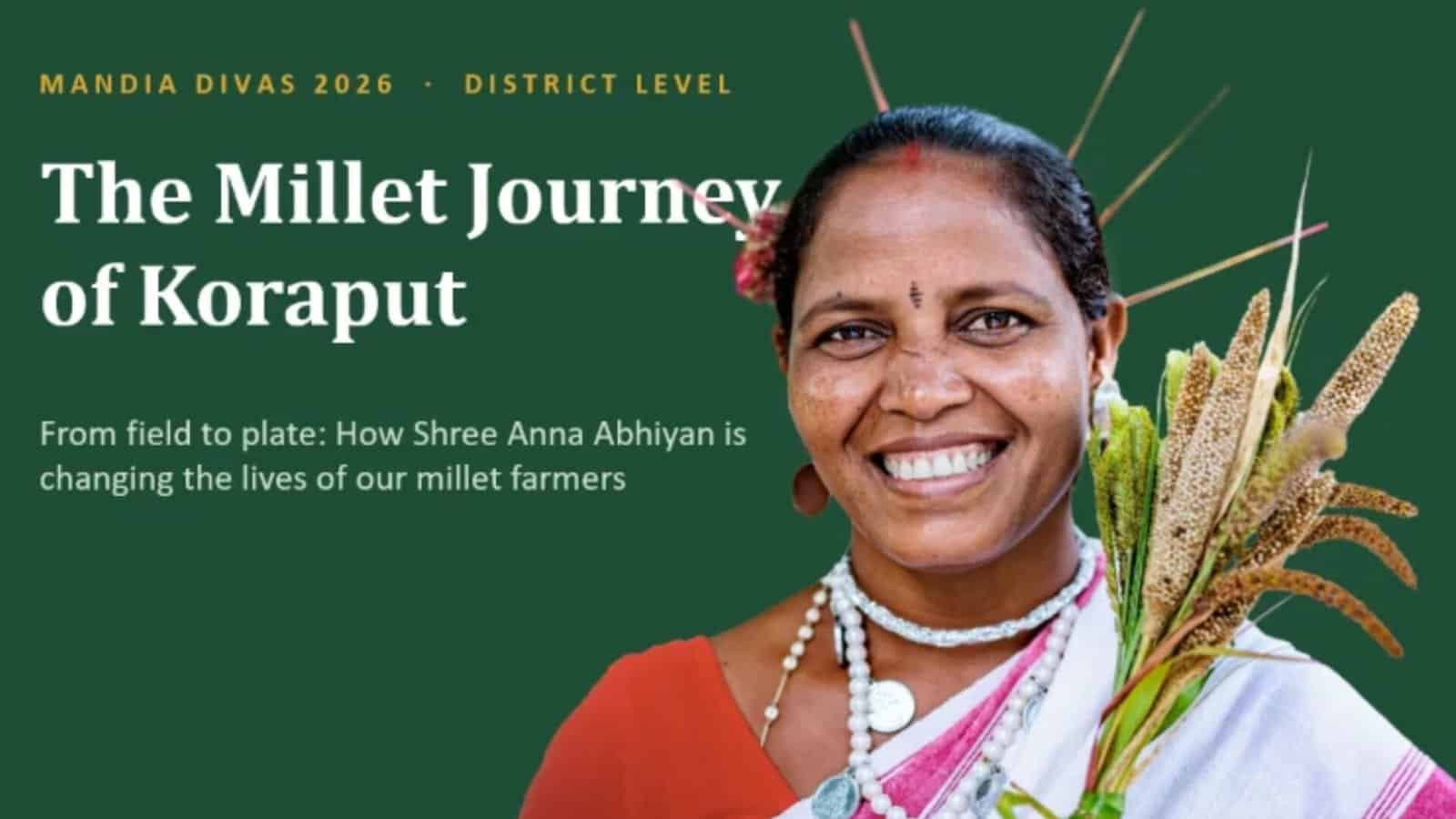
The Koraput millet journey began in 2017-18 with a modest target of 1,400 hectares. Today, under the Shree Anna Abhiyan, millets cover 15,987 hectares and reach 27,550 farmers. At the District Level Mandia Divas 2026, held at DNK Sadbhabana Sabhagruha, I presented this story as Scheme Officer, Shree Anna Abhiyan.
The celebration was graced by Sri Rupu Bhatra, MLA, Kotpad; Sri Bhagaban Muduli, Chairman, SDC; Smt. Sasmita Meleka, President, Zilla Parishad; Sri Manoj Satyawan Mahajan, IAS, Collector & District Magistrate; and Sri Bhabani Sankar Mohapatra, Chief District Agriculture Officer. Farmers, District level Officials,SHGs, FPOs, NGOs and block officials filled the hall.
Here is the story I shared that day, and why I believe it matters well beyond Koraput.
Koraput Millet Journey beginning: a 1,400-hectare dream
In 2017-18, the Government of Odisha launched a special programme to promote millets in tribal areas. In Koraput it started in just seven blocks, with 2,662 farmers and a target of 1,400 hectares. That year, 1,060 hectares were achieved.
Three more blocks joined in 2019-20, and two more in 2021-22. Today the programme, now called Shree Anna Abhiyan, runs in 12 of Koraput’s 14 blocks. In 2026-27 the numbers stand at:
- 15,987 hectares under millets, about 15 times the starting point
- 27,550 farmers covered
- 12 Facilitating Agencies and 12 FPOs, one pair in each block
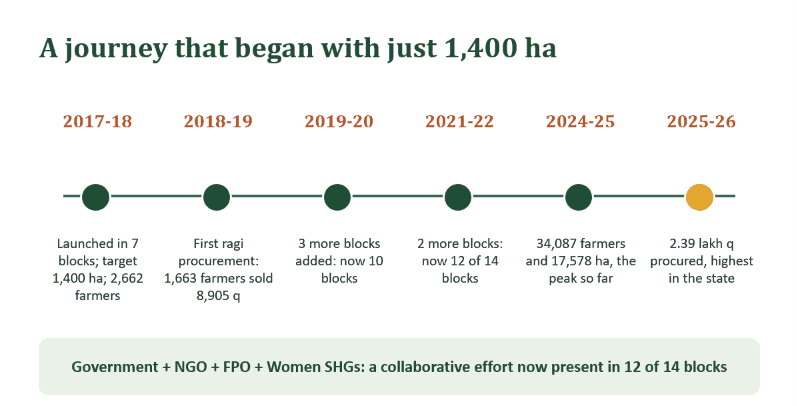
The objectives were clear from the start: revive millets from farm to plate, promote climate-resilient farming in rainfed areas, address micronutrient deficiency, improve the livelihoods of vulnerable farmers, and build women-led enterprises through SHGs and FPOs. What makes Koraput special is that the work was never done by one agency alone. Government, NGOs, FPOs, women’s collectives and research institutions pulled together.
The 4C Framework: why Koraput’s millet model works
Conservation: protecting Koraput’s millet landraces
Through Participatory Varietal Trials, 50 ragi landraces were tested with the Indian Institute of Millet Research (IIMR) in Kundra block, with farmers choosing the best performers. Seed production now covers 150 hectares across the first ten blocks. Crop Diversification Blocks keep indigenous non-millet crops alive too.
Four landraces have been released: Kundra Bati, Laxmipur Kalia, Gupteswar Bharati and Malyabanta Mami.
Koraput Bati Mandia GI tag: a proud moment for Koraput
Koraput Bati Mandia is a traditional finger millet landrace rooted in the tribal farming systems of Kundra block. It is valued for its adaptability, nutrition and cultural importance. An application for a Geographical Indication (GI) tag has been initiated by the Department of Agriculture & Farmers’ Empowerment, and the district administration has submitted all necessary documents. A GI tag would give Koraput’s own variety a protected identity in the market.
Cultivation: improved practices and farmer incentives
Three methods have been promoted:
- System of Millet Intensification (SMI): 15 to 20 day seedlings transplanted with soil, with yield potential about 50% above traditional methods
- Line Transplanting (LT): about 30% higher yield potential, with easier weeding
- Line Sowing (LS): suited to dryland areas, with about 20% higher yield potential
Incentive support per hectare over five years:
| Method | Year 1 | Year 2 | Year 3 | Year 4 | Year 5 | Total |
| Ragi, SMI | ₹10,000 | ₹7,500 | ₹5,000 | ₹2,000 | ₹2,000 | ₹26,500 |
| Ragi, LT/LS | ₹7,500 | ₹5,000 | ₹3,000 | ₹2,000 | ₹2,000 | ₹19,500 |
| Non-ragi millets | ₹10,000 | ₹7,500 | ₹5,000 | ₹2,000 | ₹2,000 | ₹26,500 |
In Kharif 2025-26, ₹7.54 crore was sanctioned to 29,256 farmers. Farmers also get seed and equipment through 89 Custom Hiring Centres and Community Managed Seed Centres run by SHGs and FPOs.
Consumption: bringing millets back to the plate
Ragi has been supplied through the Public Distribution System. Millet khichdi and laddus reach school children. A Take Home Ration pilot ran in Laxmipur block, and food festivals at district and block levels have revived traditional recipes.
Commercialisation: millet enterprises led by women
Two Millets Shakti Cafés operate in Koraput and Jeypore, run by women SHGs. Thirteen tiffin centres have been given to SHGs, and six are running successfully. Machinery support (325 pulverisers, 106 threshers, 89 RR sheller-cum-polishers, 20 little millet dehullers and 9 cleaner-cum-graders) gives SHGs and FPOs steady work.
Ragi MSP: from ₹1,900 to ₹5,205 per quintal
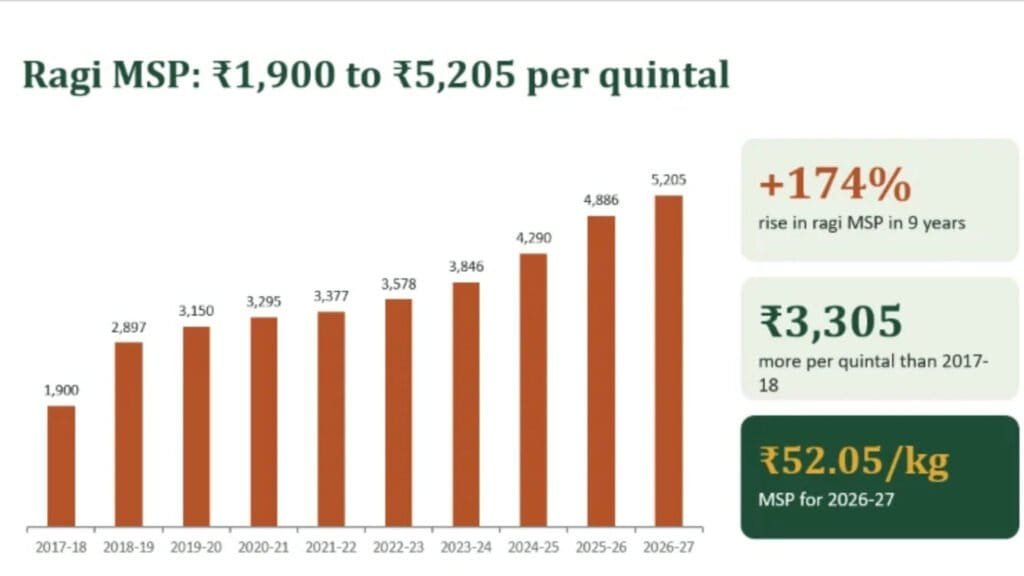
The ragi MSP was ₹1,900 per quintal in 2017-18. For 2026-27 it is ₹5,205, a rise of 174%, or ₹3,305 more per quintal. That assured price is the main reason farmers now see ragi as a crop to sell, not only to eat.
Procurement works through TDCCOL, the state procurement agency:
- Farmers register with a mandatory KO ID on the M-PAS portal.
- FPOs and LAMPCS procure at Fair Average Quality.
- Payment goes directly to the farmer’s account through Aadhaar-based transfer.
FRA patta holders and tenant farmers can also participate.
Ragi procurement in Koraput: eight years of growth
| Year | Farmers who sold ragi | Quantity procured (quintals) |
| 2018-19 | 1,663 | 8,905 |
| 2020-21 | 7,130 | 71,445 |
| 2022-23 | 14,788 | 2,06,319 |
| 2024-25 | 15,319 | 2,39,876 |
| 2025-26 | 16,667 | 2,39,458 |
Procurement grew 27-fold and the number of selling farmers grew tenfold. Multiplying each year’s quantity by that year’s MSP gives an estimated ₹410 crore paid to farmers over eight years. These are my estimates and exclude any other support.
For 2026-27, the target of 2,40,000 quintals at ₹5,205 comes to about ₹124.9 crore. That is nearly ₹8 crore more than the same quantity earned last year, purely from the higher MSP. FPOs also earn a 1% service charge, which strengthens community institutions.
Best FPO and Best Facilitating Agency: leaders of the millet movement
Jaivik Sri FPC in Nandapur block procured 40,500 quintals from 2,886 farmers, meeting 100% of its target. At last year’s MSP, that is nearly ₹19.8 crore to farmers through one FPO.
At Mandia Divas, Sabujima FPC Ltd, Boipariguda received the Best FPO award. In 2025-26 it procured 40,000 quintals from 2,589 farmers, meeting its full target. MSSRF, Jeypore was awarded Best Facilitating Agency under Shree Anna Abhiyan for its scientific research on millets, in collaboration with the Indian Institute of Millet Research, Hyderabad.
Millet Queen and young conservator honoured at Mandia Divas 2026
Dr. Raimati Ghuiria, the Millet Queen, was felicitated for her contribution to Koraput’s millets. Alongside her, Smt. Harshita Priyadarshini, a young school girl, was honoured for conserving millet landraces. One stage held the elder who kept the seeds alive and the child who will carry them forward.
Twelve progressive farmers from different blocks were awarded for adopting improved practices. The Block Agriculture Officers were recognised for their dedicated work in remote tribal villages. Their patient fieldwork is a big part of why this programme succeeded.
Every stakeholder, one mission
- Department of Agriculture & Farmers’ Empowerment, District Administration, ATMA, DPMU: direction and resources
- NGOs and Facilitating Agencies: farmer training and mobilisation through Krushak Sathis and community resource persons
- FPOs and women SHGs: procurement, processing and enterprise
- IIMR and KVK: scientific research and landrace trials
- TDCCOL and OSSC: assured procurement and quality seed
- Elected representatives: voice and community trust
- Farmers: the people who took the risk of believing in a forgotten grain
What’s next for millets in Koraput
The road ahead includes the GI tag for Koraput Bati Mandia, more seed villages and organic millet cultivation, stronger value addition and branding, deeper inclusion of millets in schools, anganwadis and PDS, and stronger FPOs and SHGs as local business leaders.
A decade ago, ragi in Koraput was a crop of memory and tradition. Today it is a crop of income, nutrition, enterprise and identity.
Author: Tapas Chandra Roy, A Certified Farm Advisor on Millets, ‘Promoting Millets from Farm to Plate ’, and an Author of two books -” Millet Business Ideas-Empowering Millet Startups” & MILLETS: The Miracle Ancient Grains. On a mission to take the forgotten grains-
Millets to Millions. To remain updated on my blogs on millets, please subscribe to my newsletter, and for any queries, please feel free to write to tapas@milletadvisor.com
FAQs
1. What is Shree Anna Abhiyan?
It is a flagship Government of Odisha programme, earlier called the Odisha Millets Mission, that revives millets from farm to plate. It promotes climate-resilient farming, tackles micronutrient deficiency and builds livelihoods through SHGs and FPOs.
2. When did the millet mission start in Koraput?
It started in 2017-18 in seven blocks with a target of 1,400 hectares. It now covers 12 of Koraput’s 14 blocks.
3. What is the MSP of ragi in 2026-27?
The MSP of ragi for 2026-27 is ₹5,205 per quintal, up from ₹1,900 in 2017-18.
4. How much ragi did Koraput procure in 2025-26?
Koraput procured 2,39,458 quintals, the highest among districts in the state. The target for 2026-27 is 2,40,000 quintals.
5. How does a farmer sell ragi at MSP in Koraput?
The farmer registers with a KO ID on the M-PAS portal. The FPO or LAMPCS procures the ragi at Fair Average Quality, and TDCCOL pays the farmer through Aadhaar-based payment.
6. What incentive do farmers get for millet cultivation?
A farmer using SMI for ragi, or growing non-ragi millets, receives ₹26,500 per hectare over five years. A farmer using line sowing or line transplanting for ragi receives ₹19,500.
7. What is Kundra Bati?
Kundra Bati is a traditional finger millet landrace from Kundra block, Koraput. A GI tag application has been initiated for it.
8. Which landraces have been released from Koraput?
Kundra Bati, Laxmipur Kalia, Gupteswar Bharati and Malyabanta Mami.
9. What are Millets Shakti Cafés?
They are millet-based cafés run by women SHGs in Koraput and Jeypore, serving nutritious millet food and providing livelihoods.
10. Who won the Best FPO and Best Facilitating Agency awards at Mandia Divas 2026?
Sabujima FPC Ltd, Boipariguda won Best FPO. MSSRF, Jeypore won Best Facilitating Agency.